
Platform Thinking in Action
How 25 established firms and almost 150 managers helped us turn Platform Thinking into an innovation method


In 2023, when we launched the first edition of the Platform Thinking HUB, we had more questions than answers.
We had spent years studying platforms, writing about them, mapping them, teaching them, and discussing their strategic potential. But one question was still open: could Platform Thinking become a real managerial practice inside established firms?
We did not know how large the phenomenon really was. We did not know whether companies would follow us in this journey. We did not know which parts of our method would survive the encounter with real projects, real managers, real constraints, and real organizational inertia.
A few years later, we have a different answer. Across the first three editions of the Platform Thinking HUB, we worked with 25 established firms, roughly 10 to 13 companies per iteration, almost 150 managers, 12 co-design workshops, and a number of one-to-one interviews. The result is now also a scientific article published in Technovation: Platform Thinking in Action.
The paper is important to us because it reconstructs how the Platform Thinking Journey was created, tested, challenged, simplified, and strengthened with companies over three years of collaborative research.
And, perhaps more importantly, it tells a story that many managers will recognize.
Today’s episode of the Platform Thinkers Spirtz will bring you behind the scenes of this paper, without the academic style, but keeping only the practical takeaways we learned from this experience.
The first barrier is rarely technological
When established firms approach platforms, the first temptation is to think in digital terms. A platform becomes a portal, an app, a data service, or a new digital layer added on top of the existing business.
But this is often where the problem begins.
Our research confirmed something we had already started to see in the work behind The Digital Phoenix Effect: many companies do not lack assets, data, relationships, know-how, or market access. They struggle because they frame platform opportunities through the old logic of products and services.
We all have learned to speak the language of platforms as users. The harder part is redesigning the way they frame problems, make decisions, and orchestrate value.
This is why the first move in Platform Thinking is not technological. It is cognitive. A platform is not just a digital service. It is a value architecture built around multiple sides, interactions, and cross-side network effects.
In established firms, this reframing often starts from very concrete business problems: missing or inefficient transactions, changing customer needs, innovation bottlenecks, underused data, or lack of data for strategic insight. Platform Thinking becomes useful when it helps a firm stop asking, ‘What new service can we launch?’ and start asking:
‘Which interaction should we enable, improve, or redesign?’
From a set of tools to a journey
The Platform Thinking Journey is the results of these 3 years, still it did not emerge as a finished method. It grew through iterations.
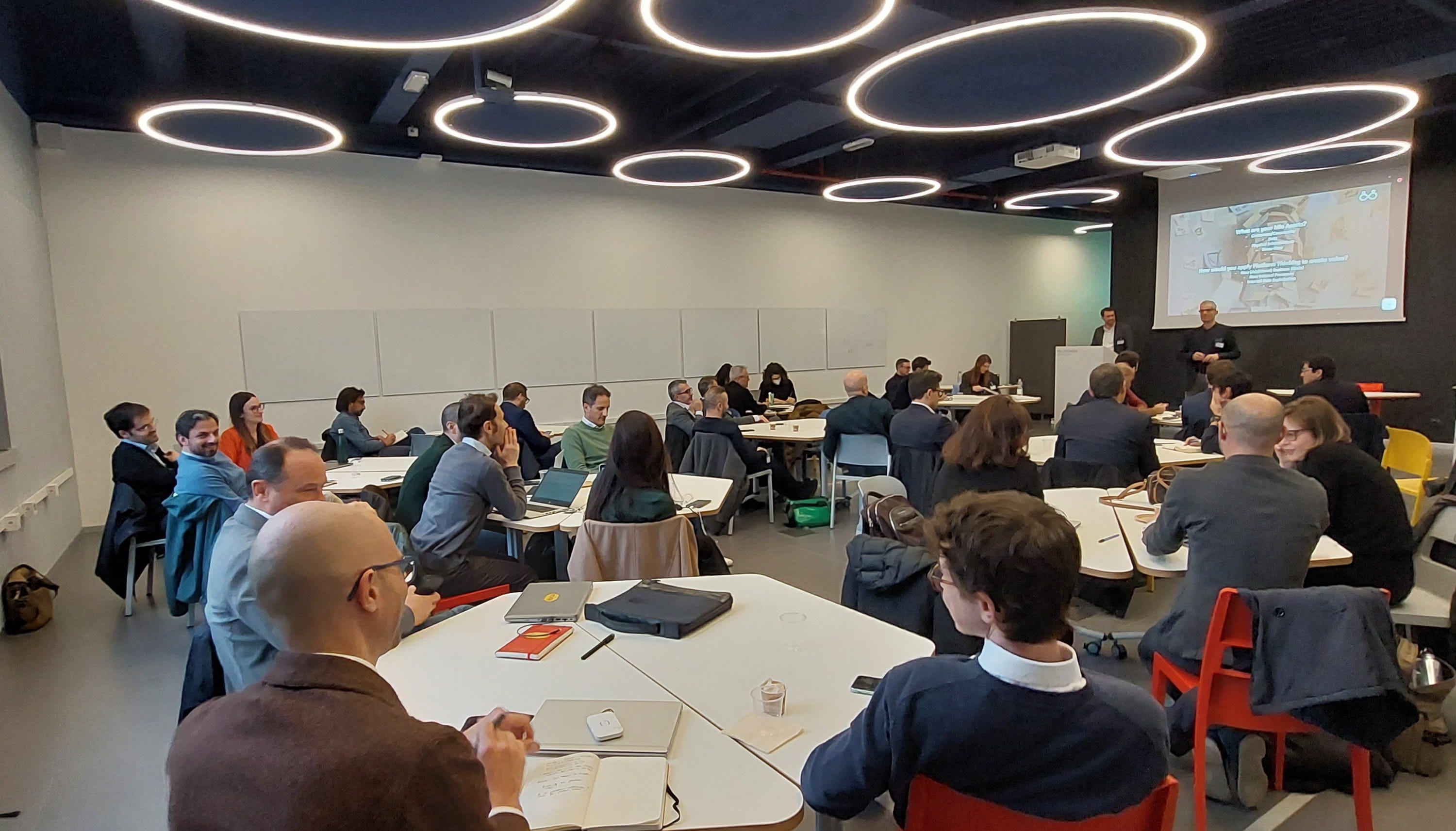
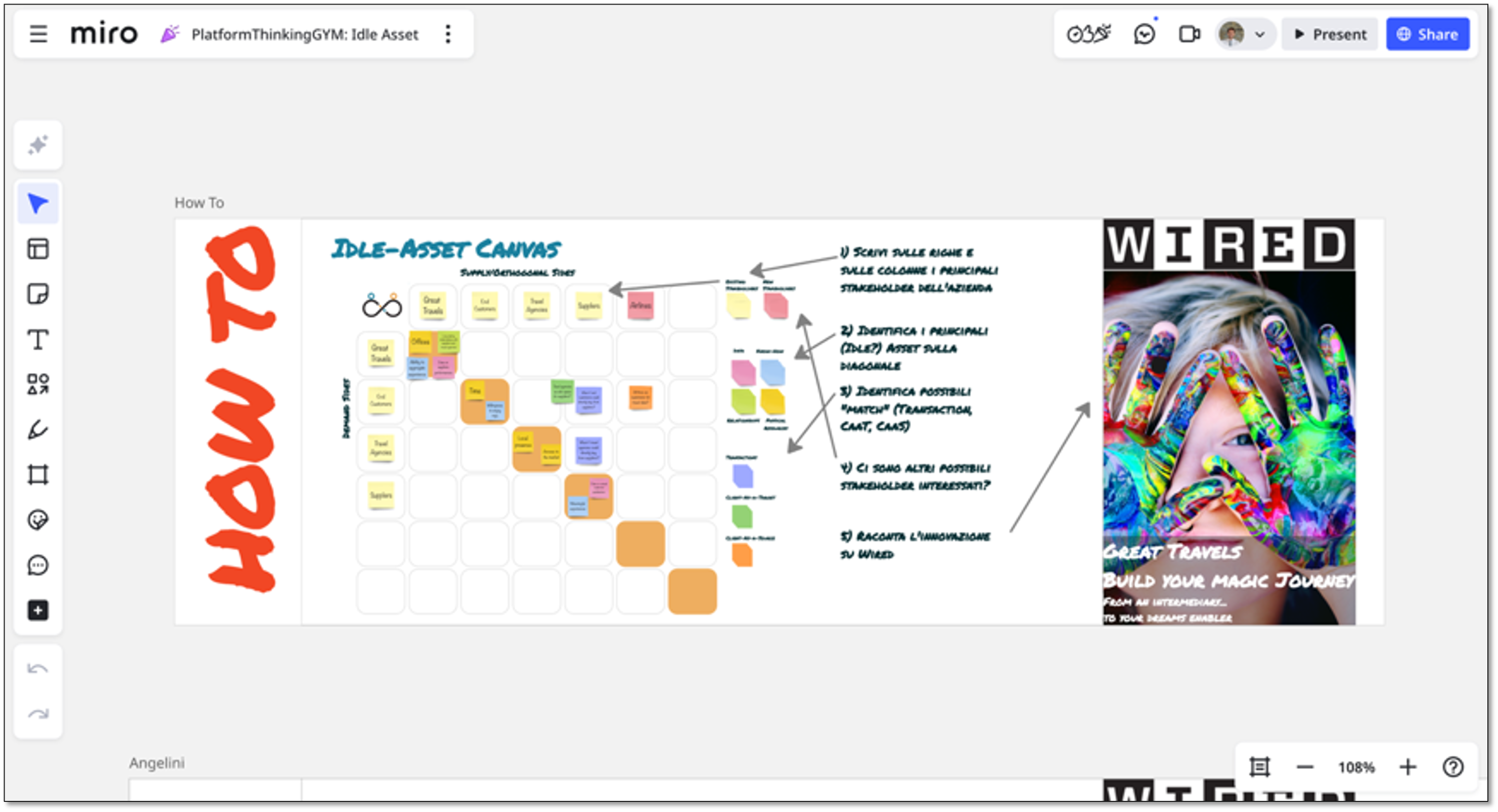
In the first wave, we used exploratory tools to help managers surface opportunities hidden in their assets, data, relationships, and ecosystems. We proposed tools like the Idle Asset Canvas and the Data Board.
It was exciting, but also messy. Teams started to see new possibilities, but they often moved from one idea to another without enough convergence. One participant captured the shift well:
‘We realized we were still thinking in products rather than in interactions.’
That sentence stayed with us. It showed that the method had to do more than stimulate creativity. It had to help managers unlearn part of the product-centric logic that makes platform opportunities hard to see.
In the second wave, we turned the tools into a more structured journey, with seven steps, 60 cards, canvases, and a clearer workshop sequence. This helped teams move forward with more discipline. Ideas matured step by step. Discussions became more structured. Choices became more visible.
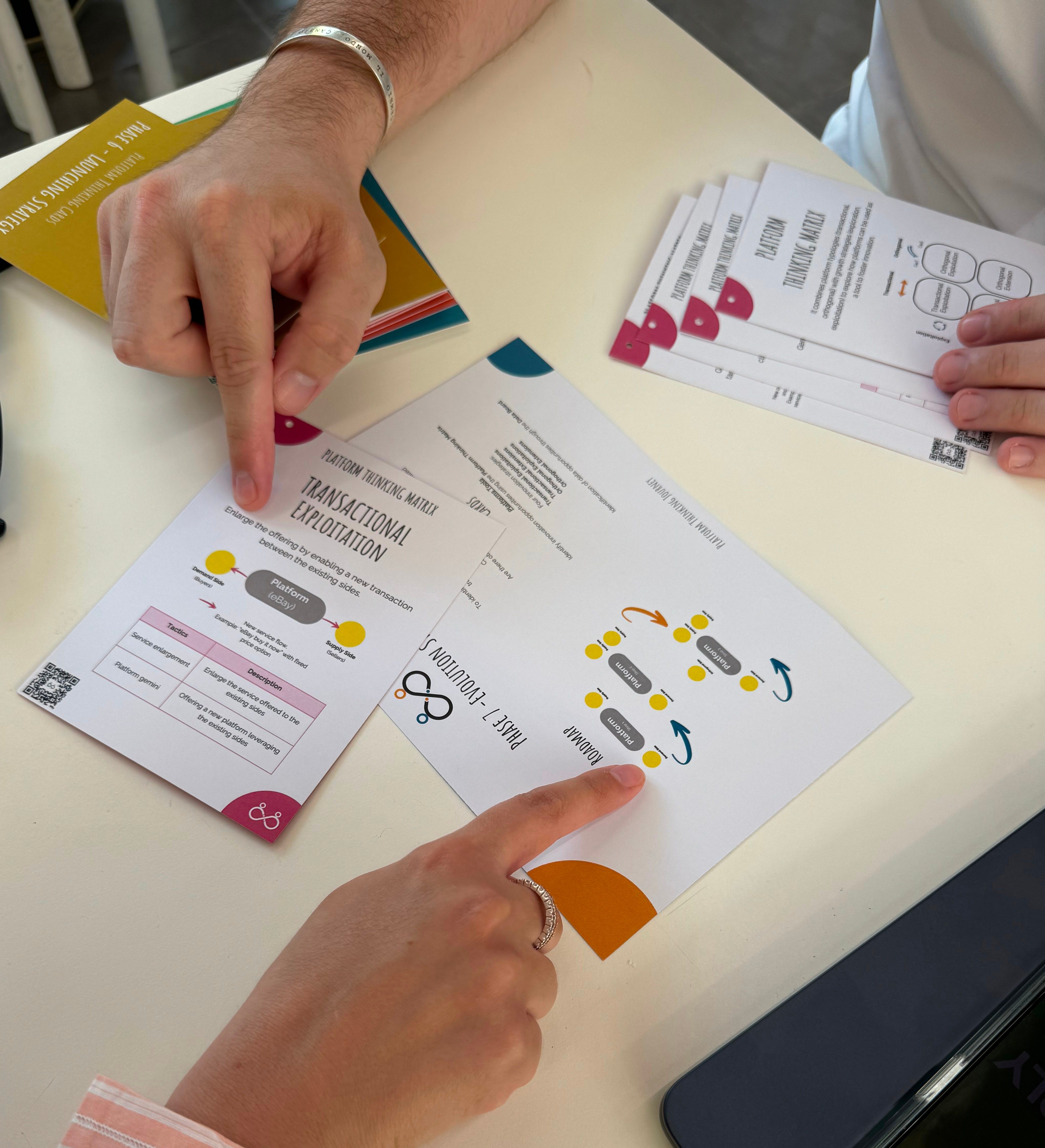
But structure created a new problem: overload. One manager told us,
‘Sometimes we felt overwhelmed, too many cards, too much information at once.’
That was another useful lesson. More content is not always more value. When the method becomes too heavy, people start following the procedure instead of thinking deeply.
So, in the third wave, we simplified the journey. We moved from seven steps to four phases: Framing, Design, Ignition, and Growth. We reduced and redesigned the cards. We clarified the logic of each step. And we introduced a GenAI co-thinker (thanks to Elisa Farri and Gabriele Rosani’s collaboration) to support reflection during and between workshops.
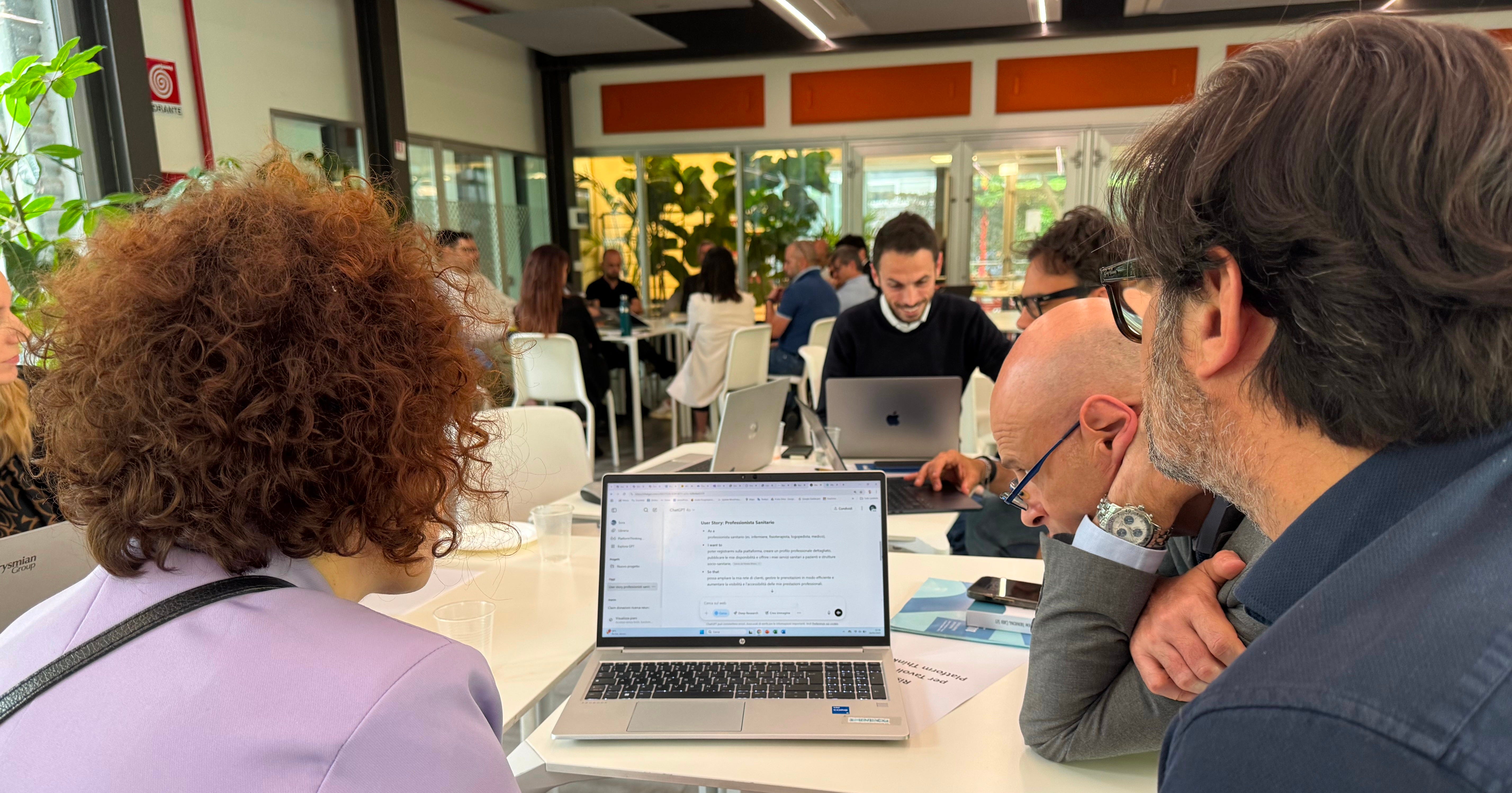
The GenAI co-thinker was designed as a sparring partner: a way to clarify concepts, recall examples, challenge assumptions, and keep the reasoning alive between sessions. As one participant put it,
‘It was like having a sparring partner always available.’
This also brought to our first HBR publication with Gabriele Rosani and Elisa Farri, which you can find here.
The logic of the Platform Thinking Journey
The final version of the Platform Thinking Journey is a repeated decision cycle.
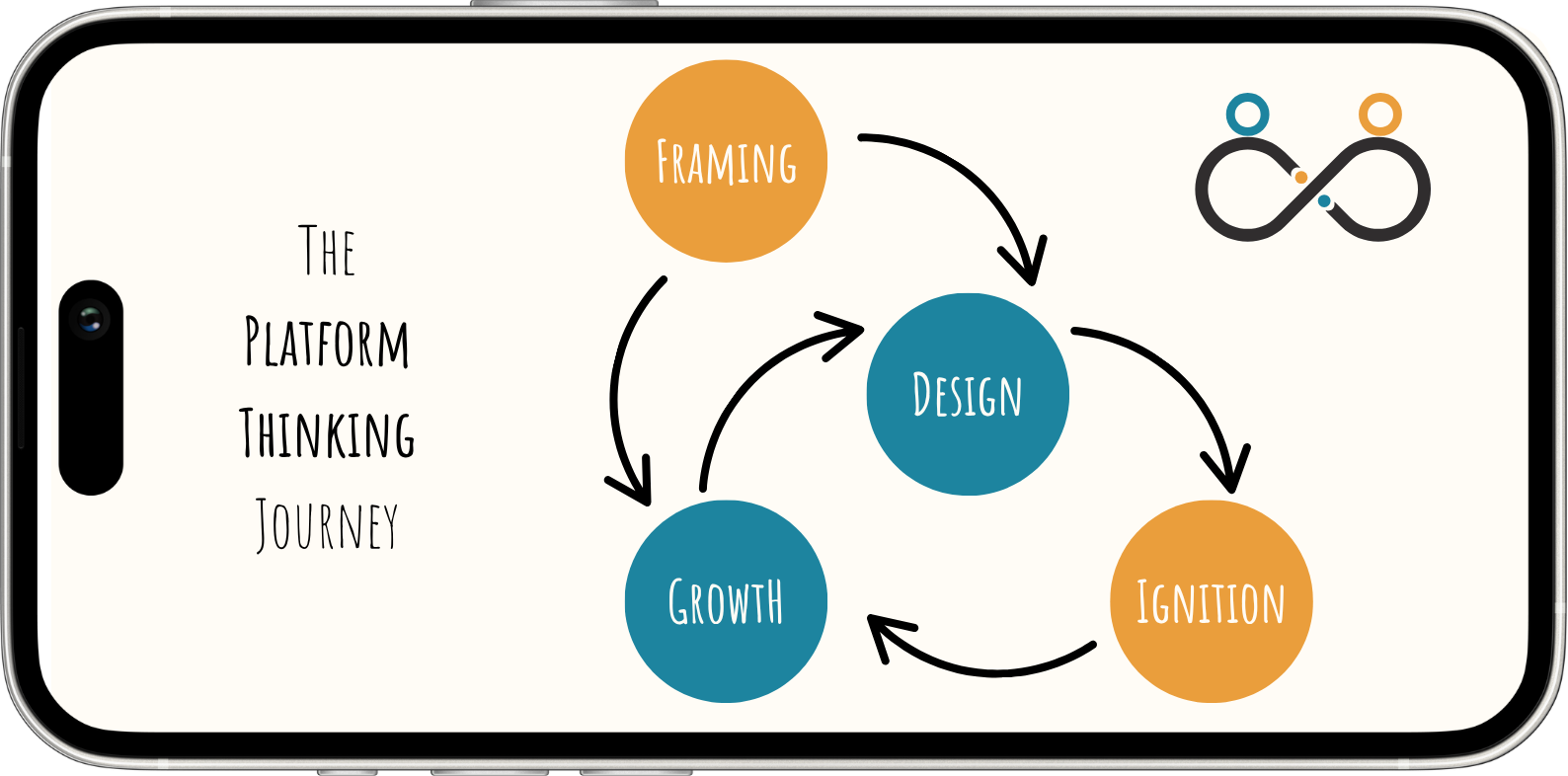
Each cycle starts with a triggering question. The question narrows the design space and forces the team to focus on one managerial issue at a time. Where should Platform Thinking be applied? Why does this problem need a platform logic? Which type of platform best fits the opportunity? Which side should be activated first? How can the platform grow over time?
Then, the journey introduces literature-based alternatives. This is a crucial point. We do not ask teams to brainstorm from a blank page. We expose managers to structured alternatives grounded in platform research and in cases observed across industries. This reduces ambiguity. It also prevents teams from using the same word, platform, while imagining very different things.
The third element is the use of tools: cards, canvases (also the Idle Asset Canvas and the Data Board, coming back from the first iteration 😄), and so on. These tools make reasoning visible, and they sustain it. They turn abstract strategic conversations into objects that teams can discuss, compare, challenge, and improve.
Finally, each cycle ends with a milestone. A milestone is not a bureaucratic checkpoint. It is a moment of coherence. It asks whether the team has really clarified the decision before moving forward.
This is what makes the method practical. It does not promise that platform innovation becomes easy. It makes the hard parts explicit. It slows teams down where mis-framing is dangerous, and it helps them move faster once the underlying logic is clearer.
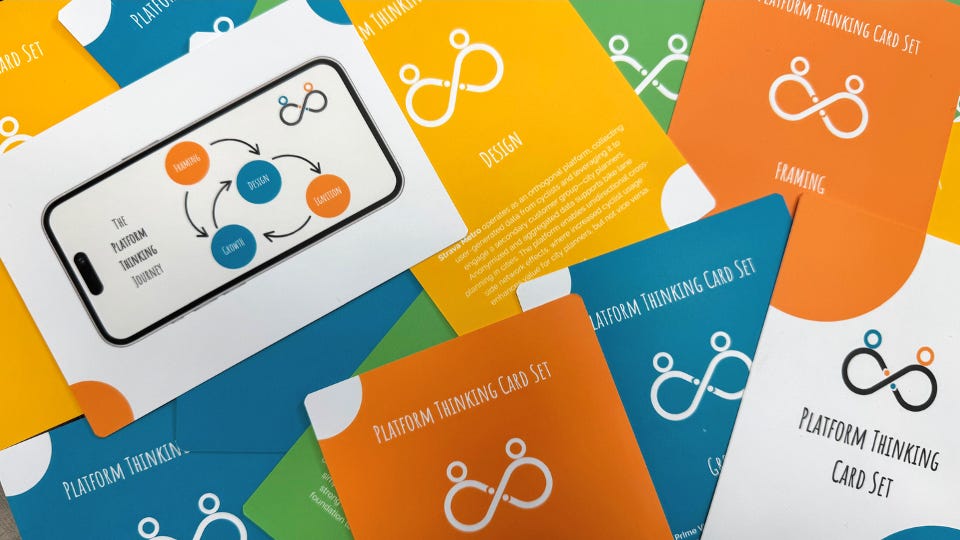
The method is out there, in the paper, there are the design principles, but if you want to use it, get it for free on Miro, or you can get the physical cards as well.
Four phases, four managerial jobs
Framing: helps managers understand where and why Platform Thinking is relevant. It shifts attention from products and services to actors, interactions, and ecosystem problems.
Design: makes the architecture explicit. It clarifies sides, value propositions, platform typology, functionalities, business model choices, and trade-offs.
Ignition: addresses one of the most underestimated questions in platform projects: how do the first interactions actually start? It forces teams to reason about onboarding, sequencing, side activation, and early liquidity.
Growth: moves the platform beyond the first launch. It helps teams see the initiative as an evolving system that can expand by adding sides, exploiting data, extending services, or recombining assets over time.
For managers, the value is not only in the four phases. The value is in the discipline they create. Platform projects often fail because decisions remain implicit, scattered across functions, or hidden behind attractive digital language. The journey makes these decisions visible before the organization invests too much in the wrong direction.
This matters especially for established firms. They often have strong assets, but also strong habits. They can leverage installed customer bases, trusted brands, supplier networks, industrial know-how, data, and organizational legitimacy. But those assets become platform advantages only when they are reconfigured around interactions, not simply added to another digital service.
A method built with companies, not only for companies
One of the most meaningful aspects of this research is that the method was not designed in isolation and then delivered to companies. It was built through a collaborative process with companies that brought their own problems, doubts, constraints, and ambitions into the room.
Across the first three editions, we had the opportunity to work with: Angelini Industries, ENI, Epta, Sintetica, Edenred, Gruber Logistics, Poste Italiane, Prysmian Group, SDF, Sisal, Alpitour World, GS1 Italy, Iveco, Leonardo, Relatech, Retail Reply, Trentino Sviluppo, GPS Bilance, EY with Board, and Istituto Neurologico Nazionale Fondazione Mondino IRCCS, represented by almost 150 managers who joined the workshops over the years.
Seeing the method grow with them has been both exciting and challenging. Exciting, because every edition showed that Platform Thinking could help managers see new possibilities in their existing business. Challenging, because every edition also exposed something that was not working yet.
That is exactly what made the research valuable. The companies did not simply validate the method. They helped us redesign it, while they were using it for their own projects. They pushed us to simplify it, make it more concrete, make it more usable, and make it more resilient to the real complexity of platform projects.


Where the journey is going now
The paper captures the 2023-2025 research journey. But the project has not stopped.
With the fourth edition of the Platform Thinking HUB, which we have just closed, the method is moving further into the world of GenAI and internal platforms. We are exploring how platform logic can redesign internal collaboration, knowledge flows, data access, and organizational interfaces. At the same time, within the Observatory, we keep experimenting with the results of this research also on projects that go beyond internal platforms. The Fujitsu case was our source on inspiration…more to come in the next months.
This is probably the most important message for managers:
Platform Thinking is not a label to attach to a digital initiative. It is a way to ask better questions about value creation.
Platforms have already changed the way we live as users.
And yet, when we enter our organizations as managers, our eyes often go back to the linear world we grew up in.
This is why Platform Thinking needs a journey.
For us, the research is not over, but this piece of research is a key milestone in our journey. Reach out if you test it, we’d like to know your experience with it!
If you liked this piece, you may like The Digital Phoenix Effect, which is celebrating one year from the release, and that’s free in e-book on Amazon till June 23rd, 2026.
Reference
Trabucchi, D., & Buganza, T. (2026). Platform Thinking in Action: A design science research to bring the platform revolution in legacy firms. Technovation, 156, Article 103629. https://doi.org/10.1016/j.technovation.2026.103629